

Throughout the centuries, humanity has found countless ways to include cats in our paintings, literature, stories, jobs and everyday lives. You can find cats in art across the world, but the way people have depicted them has changed from one culture to the next.
In ancient Egypt, cats became closely associated with the goddess Bastet. Elsewhere, they became symbols of luck, protection, independence, femininity, danger and even the supernatural.
Some of those associations treated cats kindly. Others did them no favours at all. As the owner of two black cats, one example stands out to me: the idea that black cats bring bad luck or belong beside witches as familiars. Those beliefs followed black cats for centuries, and we still see the impact of those associations today. I don’t know about you, but I still see many rescues desperately making calls for adoption applications for black cats because they don’t receive as many. It’s a shame and heartbreaking too. They can be every bit as loving, daft and full of character as any tabby, ginger or grey cat.
Anyway, that is only one part of a much bigger story.
Over time, artists have depicted cats as sacred animals, hunters, companions, symbols, comic characters and anime characters (such as Alpine and Luna) and beloved pets. Some cats became part of famous works. Others simply belonged to the artists themselves, and they just wanted to create cat artwork inspired by their beloved furry companion.
As we look at cats in art throughout history, I want to go beyond pointing at a painting and saying, “there’s a cat.” As fun as that is. I want to look at why the cat is there, what it meant at the time, and what that tells us about the people who put it there. Of course, like with any artistic creation, the meaning I pull from each one may differ from your own. Our life experiences impact the stories, meaning and lessons we see in art.
Table of Contents
The meaning of cats in Egyptian art
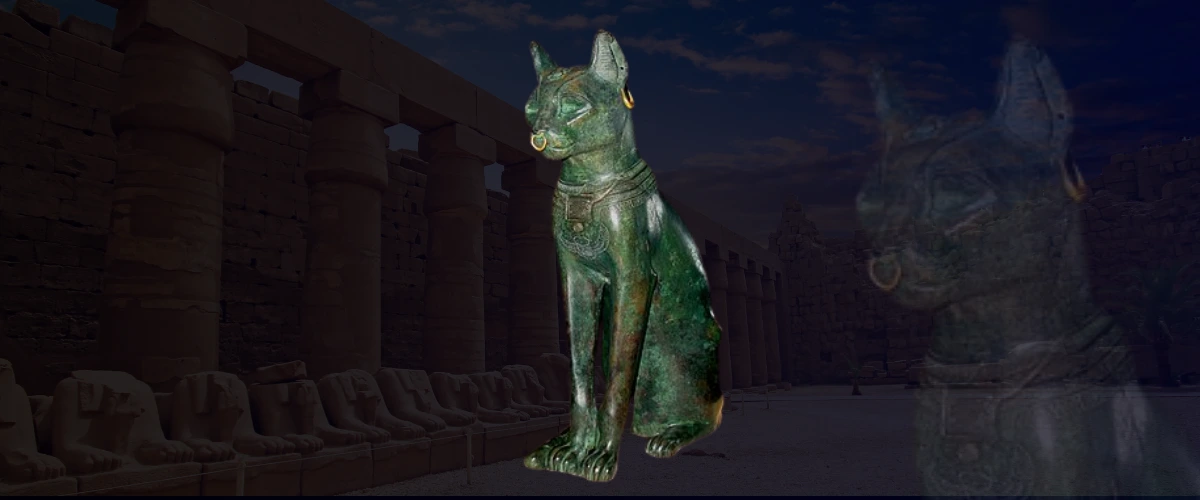
When you think about cats in art from ancient Egypt, your mind may jump straight to Bastet and those elegant bronze cats sitting upright with their ears pricked.
Some of the best-known surviving cat figures come from religious settings, and Bastet became one of the strongest links between cats and ancient Egyptian belief. But if we stop there, we miss a large part of the story.
Cats also lived alongside the people who worshipped those very Gods. They caught mice, rats and snakes around homes and food stores. They appear beside their owners in tomb paintings, under chairs and out in the marshes during hunting scenes. In other words, we see the different roles cats had in Ancient Egypt.
One of the most famous examples sits in the British Museum today. The Gayer-Anderson Cat, made around 600 BC, shows Bastet in feline form. The bronze cat sits upright and wears golden earrings, a nose ring and a silver protective pectoral. A scarab appears on its head and chest, while a wedjat eye on the pectoral carried associations with protection and healing. The British Museum says figures like this came from temple settings, where worshippers dedicated bronze images of gods as offerings.
If you look at the sculpture, the artist has not made the cat look soft or playful. It sits alert, upright and composed. You can see why a culture might connect that pose with protection. Anyone who has watched a cat sit motionless while taking in every sound in the room will recognise some of that watchfulness.
But this does not mean every cat in ancient Egypt wandered around as a living god.
The British Museum makes the distinction clear. Egyptians valued cats as pets and as hunters of vermin, while cats also gained religious importance through Bastet. The Metropolitan Museum of Art describes cats as sacred to Bastet and records people dedicating cat statuettes at temples or placing them in catacombs alongside cat mummies at places such as Bubastis and Saqqara.
What about cats in medieval art?
By the Middle Ages, cats had moved into a very different visual world.
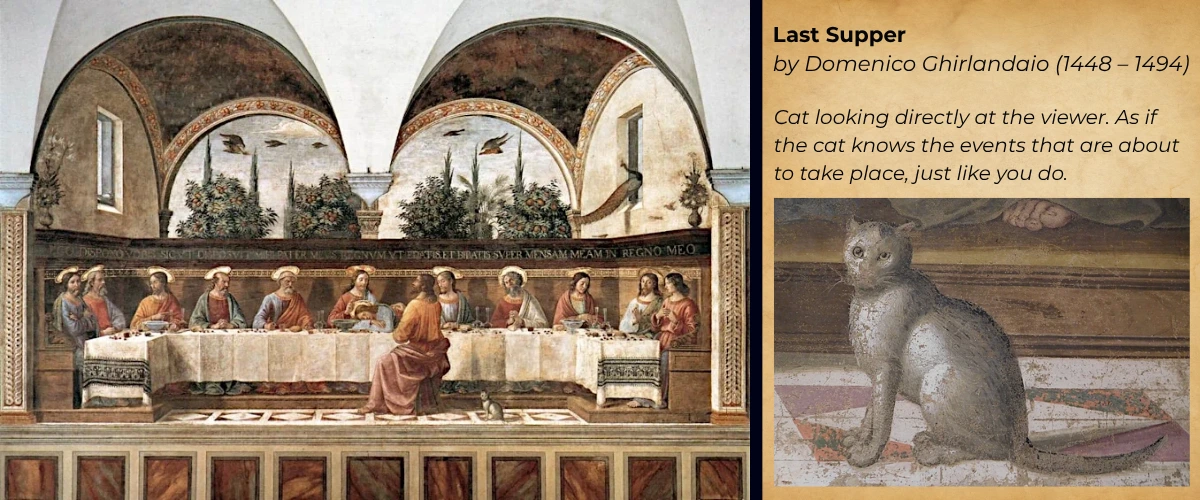
You find them in illuminated manuscripts, bestiaries, religious texts and marginal drawings. Sometimes they chase mice. Sometimes they sit beside people as companions. Sometimes medieval artists use them to make a moral or religious point. And sometimes they seem to have included a cat because cats are excellent at getting into places where they are not supposed to be.
That last part is not entirely a joke, as I’m sure most cat owners are aware… especially when they are not feeling well, and you’re trying to find them in their usual napping spots, but this time round they decide to change said spot to just give you a little scare. Could do without those mini heart attacks haha.
Medieval people valued cats for practical reasons. They hunted mice around homes, monasteries and food stores, and they also kept people company- much like Ancient Egyptians. The British Library notes that cats appear in texts as both mousers and companions, especially among people living religious or scholarly lives.
One 7th-century riddle by Aldhelm, abbot of Malmesbury, describes a night-time hunter that sees in the dark and lays traps for thieves stealing grain. The answer is a cat. By the early 13th century, the Ancrene Wisse, a guide written for female religious recluses, allowed them to keep one animal companion, and you guessed it!
The Middle Ages did not consist of several hundred years in which everybody hated cats.
Cats certainly picked up negative associations in parts of medieval European culture, and later links with witchcraft caused them no favours. But the surviving evidence also shows people keeping them, writing about them and appreciating their ability to deal with mice.
One of the loveliest examples comes from a 9th-century poem known as Pangur Bán.
An Irish monk wrote about his white cat, Pangur Bán, while living in Germany. Instead of treating the cat as a symbol of evil or a moral warning, he compares their work. The monk searches for knowledge while Pangur hunts mice. Both sit absorbed in what they do.
You can picture someone trying to work while their cat gets on with a completely separate mission nearby. More than a thousand years later, plenty of us still understand and even have that arrangement. Just like farmers sometimes keep feral cats on their farmland, and breweries have a “chief” cat that hunts any mice or rats.

Cats in the medieval bestiary
Cats also appeared in bestiaries, illustrated books that brought together descriptions of animals, inherited stories and religious teaching. They were not wildlife guides in the modern sense. A bestiary might place a familiar animal such as a cat beside creatures its writer or illustrator had never seen, including elephants, lions and even unicorns. The Getty explains that these books used animals to communicate ideas about Christian belief and morality, while also entertaining the people who read them.
This gives us one of the more interesting examples of cats in art during the Middle Ages. Unlike many exotic animals in bestiaries, cats lived close to the people creating these manuscripts. A 13th-century English bestiary held by the British Library shows two cats with mice. One chases its prey, while the other grips a mouse between its paws. The image reflects one of the cat’s most familiar jobs at the time, keeping pests under control.
That does not mean every medieval cat looks convincing to modern eyes. Some look wonderfully strange, with stretched bodies, almost human faces or paws that look more like hands. However, we should be careful before deciding that the artist simply could not draw a cat. Medieval manuscript artists did not always aim for the kind of physical accuracy we might expect from later natural-history illustration. The image had another job to do. It needed to support a story, a lesson or an idea, and the Getty notes that bestiary images often served those meanings rather than acting as realistic studies from life.
So when you come across an odd-looking cat in a medieval manuscript, the more interesting question is not always, “Why does that cat look like that?” It is “Why did the artist put the cat there?” Sometimes the answer is simple: the cat is catching mice. In other cases, it may point to companionship, religion, morality or some other part of medieval life. That is what makes cats in art throughout history so fascinating to look at. You’re basically trying to put together a story through the image in front of you.
The image may seem strange to us, especially when proportions and expressions weren’t exactly the best executed artistic ventures back in those days… which is understandable; it can be incredibly difficult! However, as already covered, realism isn’t always the aim. The aim is telling a story, which can reveal something to the viewer about the long relationship between people and cats.

How cats in art changed through Renaissance and later European art
As we move into the Renaissance and later European art, cats in art start appearing in a wider range of domestic, religious and family scenes. However, artists did not stop using them as symbols. A cat could still carry another meaning while also looking very much like an animal that belonged in the household.
Federico Barocci gives us a good example in The Madonna of the Cat, painted around 1575. At first glance, the scene feels warm and familiar. Mary sits with the infant Christ while the young John the Baptist dangles a goldfinch above a cat waiting to pounce. Joseph watches from behind them. If you ignored the biblical identities for a moment, you could almost read it as a family watching a child tease the household cat. The National Gallery describes the setting as a Renaissance bedchamber, which makes the religious figures feel part of an ordinary domestic space.
But Barocci has not placed the cat there for background entertainment. The goldfinch carried a traditional association with Christ’s future Passion, while the cat waits beneath it, ready to spring. The National Gallery also notes that the cat and John the Baptist’s reed cross may connect with the coat of arms of Antonio Brancaleoni, who commissioned the painting. So once again, cats in art can work not only as part of the story, but as a symbol too.
The cat helps make the scene look like your average, warm family life, while still carrying symbolic weight within the painting.
That mix makes this period so interesting. You can recognise ordinary feline and human behaviour while the artist uses that behaviour to support a larger story. The cat does not need to stop acting like a cat in order to hint at or give another meaning to the story depicted.
A couple of centuries later, Thomas Gainsborough gives us a far more personal scene in The Painter’s Daughters with a Cat. Painted around 1760, the unfinished portrait shows his daughters Mary and Margaret pressed close together while Margaret holds their cat. The animal looks less interested in sitting nicely for the family portrait and more interested in leaving the situation altogether. To be fair, if I were being held like that, I also wouldn’t be best pleased. Looking at it, it doesn’t feel like the cat is being supported properly, which means the cat is highly uncomfortable, to say the least.
The National Gallery describes Mary as helping her younger sister with the writhing cat while also holding her with affection and protection.
I love this one because you do not need to hunt for a complicated symbolic explanation before the image gives you something recognisable. Some cats, of course, simply do not like to be picked up, so they start wriggling about before you can actually hold them in a supportive manner. I discovered Crumble doesn’t like being picked up, but it wasn’t through her wriggling. She stiffens up like a board and starts to shake. She’s an interesting cat haha.
Anyway, anyone who has tried to hold a cat that has decided it no longer wishes to be held will understand the problem.
This painting also gives us something different from the religious objects, manuscripts and moral lessons we have already looked at. Here, the cat belongs inside a family portrait. It shares the space with the artist’s children and becomes part of a small moment between them.
That does not mean symbolism disappeared from European cats in art. Artists still used cats to suggest ideas about human behaviour, disorder, sexuality and other qualities, depending on the work and period. Yet paintings like Gainsborough’s also show a relationship that feels much closer to the one many of us know today. The cat was part of their family life, and Gainsborough chose to include that moment in the portrait, even if the cat looks thoroughly unimpressed with the arrangement.
How cats in art took on a life of their own in Japan
If you want to see artists having fun with cats, Japanese ukiyo-e (a genre of Japanese art) gives you plenty to work with. It’s honestly one of my personal favourites. I have a lot of love for Japan in general, and when it comes to their artistic expression, I’m no different.
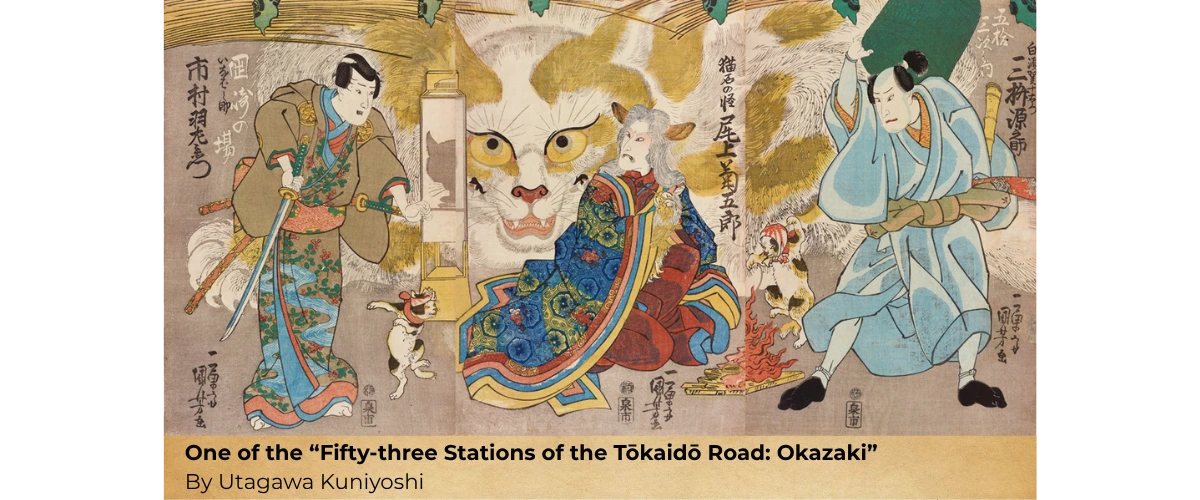
By the Edo period, cats had become a hugely popular subject in woodblock prints. Artists did not stop at drawing them realistically. They turned them into schoolchildren, restaurant customers, performers, monsters and even political caricatures. The Ota Memorial Museum of Art describes cats as the most popular animal subject in ukiyo-e, with prints showing them dancing, attending school, eating noodles and taking on human roles.
This is where cats in art start becoming less about simply using them as a symbol or representation of a meaning in a story, and more about using the cat as a character.
Utagawa Kuniyoshi pushed that idea further than most. During the Tenpō Reforms of the 1840s, the Tokugawa shogunate restricted popular subjects such as famous actors and courtesans. Kuniyoshi responded by leaning into caricature and anthropomorphised animals. His cats juggle, pull faces, mimic actors and contort themselves into written characters. Some of his satirical prints attracted enough attention from the authorities for officials to question him over their possible political meaning.
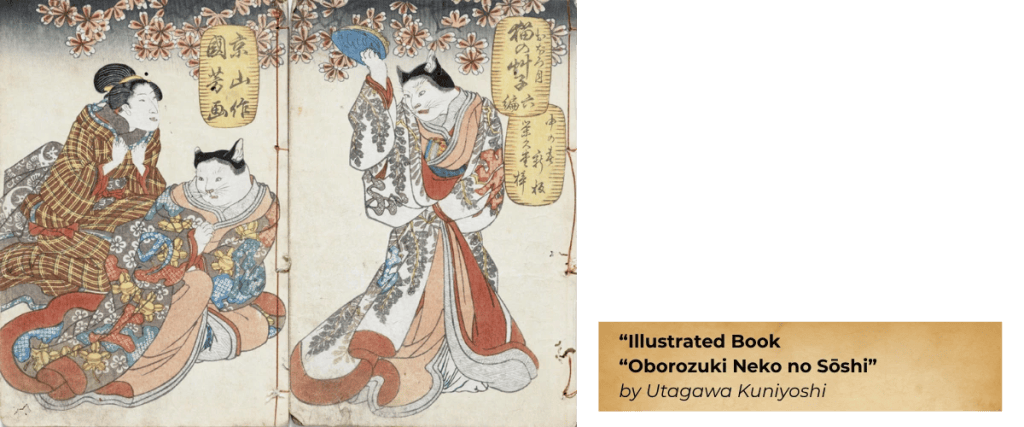
In these prints, the cat could step beyond symbolism and become part of the action. Artists could use cats to parody people, poke fun at popular culture, build characters and tell stories that audiences could recognise and enjoy.
That’s what makes this period so interesting and fun! The cat was no longer just being used in the background in a supporting role or to carry symbolic meaning. It could become the character itself. It also gave artists a way to express ideas, thoughts and beliefs, while treading a fine line with the restrictions of the time. Kuniyoshi took that idea, expanded it and sprinkled a touch of humour on it. You can see why so many of his cat prints still catch people’s attention today.
Japanese art also gives us a useful bridge into the next part of the history of cats in art. Once artists start treating cats as recognisable characters with their own personalities, it becomes much easier to see how we eventually arrive at comic cats, animated cats and the feline characters we know and love today.
The role cats play in comics, anime and movies in recent years
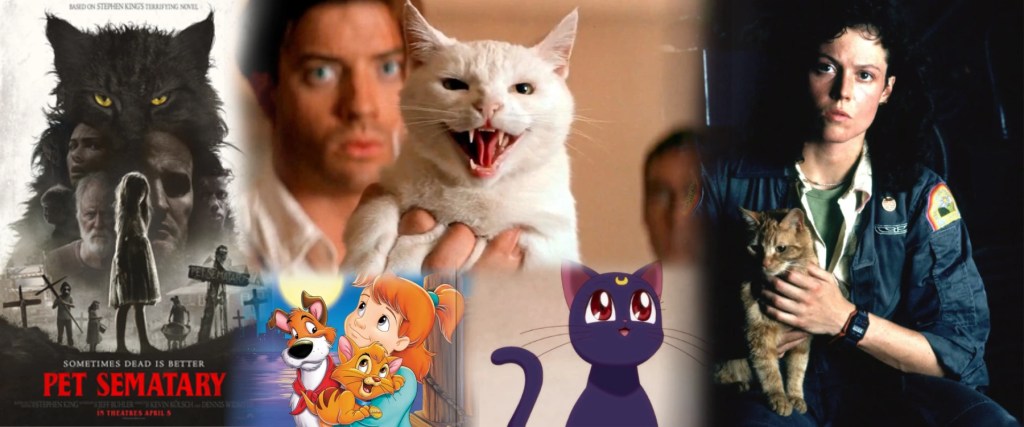
As cats moved into comics, anime and film, creators have been able to give them much bigger roles. Some became characters with personalities and stories of their own. Felix the Cat became an early animation star; Garfield developed an entire personality around food, sleep and sarcasm, while manga and anime gave us characters such as Luna from Sailor Moon, Jiji from Kiki’s Delivery Service, and The Baron from The Cat Returns.
Then you have characters such as Alpine, Bucky Barnes’s white cat in Marvel Comics. Alpine doesn’t need to talk, perform magic or save anybody. Her relationship with Bucky gives us a glimpse of his personal life and adds a softer side to a character better known for considerably less cuddly situations.
We see them in movies as well. In adaptations such as Stephen King’s Pet Sematary, the cat plays a much more central role. In other films, such as The Conjuring, cats can appear in more subtle ways. In the Conjuring movie, in one of the girls’ bedrooms, you can see a painting of a cute white cat among the set decoration. It could, of course, simply be a picture of a cat. However, I read it differently. To me, the soft white cat reflects the innocence of the children living in the house, which makes an interesting contrast with the evil presence tormenting them in their home.
I can’t say that was the filmmaker’s intended meaning, and that’s part of what makes looking for cats in different art forms so fun. It’s like a little puzzle you’re trying to put together, guessing the meaning of something so subtle.
A cat does not need to be the main character to affect how you read an image or story. Sometimes it is tucked into the background waiting for an eagle-eyed viewer to spot it, and what you take from it may depend on your own experiences and associations.
Final Thoughts…
Looking back through the history of cats in art, one thing becomes clear: people have rarely been able to resist putting cats into the things they create. Ancient Egyptians connected them with Bastet and protection, medieval artists placed them into manuscripts and bestiaries, Renaissance painters brought them into religious and family scenes, and Japanese artists turned them into characters capable of causing as much trouble on paper as real cats do at home.
That relationship kept changing as art changed. Cats moved into comics, anime and film, where they could become heroes, companions, sources of humour or small visual details that add another layer to a story. Sometimes we know exactly why an artist included one. Other times, all we can do is look at the work, consider its context and decide what that cat means to us.
I think that uncertainty is part of what makes cats in art so enjoyable. You can learn about the culture and history behind an artwork while still bringing your own experiences into the way you read it. And considering cats are still inspiring paintings, illustrations, films and artwork today, I doubt we’re going to stop putting them into our creative work any time soon.
FAQs
Where can I find limited edition prints of cats by contemporary artists?
If reading about cats in art has made you want one for your own walls, start with artists and galleries that clearly state the edition size, printing method and whether the work has been signed or numbered.
The Society of Feline Artists is one I want to put forward, because the whole gallery focuses on domestic and wild cats, with original work and prints from practising feline artists. Some of its limited edition prints are signed and numbered and come with certificates of authenticity.
You can also browse Print Club London for limited edition work by contemporary printmakers, or look directly at artists whose work you like. For example, Mychael Barratt has produced limited edition cat prints that play with famous artists and art history.
Are there subscription services for receiving cat-themed art prints?
Yes, although dedicated cat art subscriptions are less common than general art print clubs. One current example is Tokyo’s Snail Meow Print Club, which sends subscribers a different hand-signed cat art print each month as part of a 12-print series.
If you are happy to branch out beyond cats in art, The Zoologist Print Club sends signed animal artwork and other illustrated pieces each month, with each edition built around a different environment.
Print clubs change their themes, availability and sign-up dates quite often, so it is worth checking exactly what you will receive before subscribing.
Are there galleries in London that showcase animal or pet artwork?
London doesn’t have many permanent galleries devoted entirely to pet art, but several venues regularly host animal and wildlife exhibitions.
Mall Galleries is a good one to keep an eye on. It hosts The Natural Eye, the annual exhibition of the Society of Wildlife Artists, as well as events such as the David Shepherd Wildlife Foundation’s Wildlife Artist of the Year. These shows include painting, drawing, sculpture and printmaking centred on animals and the natural world.
For something much closer to cats in art, follow the Society of Feline Artists. The society has held physical exhibitions around the UK and previous London shows dedicated entirely to feline artwork, alongside its online exhibitions. Just make sure to check its current exhibition programme before planning a visit.